i have a big interest in that absolute zero of nothingness
tippy toeing on the razor edge of one's quest for balance
'Truth is a pathless land' - Jiddu Krishnamurti
Published by Indian on January 28, 2009 1:38am. Category: many roads, many choices
i love to to find little known people who make tremendous inroads into the minds of those more known souls from whom i have gleaned some of my own interpretations.
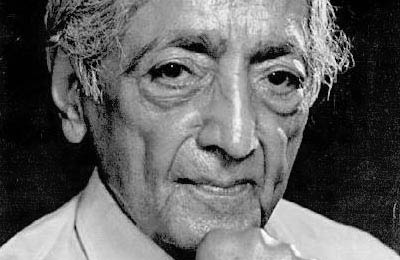
J. Krishnamurti fills that bill just dandy!...................... enjoy!
Jiddu Krishnamurti
'When we are aware of ourselves, is not the whole movement of living a way of uncovering the "me," the ego, the self? The self is a very complex process that can be uncovered only in relationship, in our daily activities, in the way we talk, the way we judge, calculate, the way we condemn others and ourselves. All that reveals the conditioned state of our own thinking, and is it not important to be aware of this whole process? It is only through awareness of what is true from moment to moment that there is discovery of the timeless, the eternal. Without self-knowledge, the eternal cannot be. When we do not know ourselves, the eternal becomes a mere word, a symbol, a speculation, a dogma, a belief, an illusion to which the mind can escape. But if one begins to understand the "me" in all its various activities from day to day, then in that very understanding, without any effort, the nameless, the timeless comes into being. But the timeless is not a reward for self-knowledge. That which is eternal cannot be sought after; the mind cannot acquire it. It comes into being when the mind is quiet, and the mind can be quiet only when it is simple, when it is no longer storing up, condemning, judging, weighing. It is only the simple mind that can understand the real, not the mind that is full of words, knowledge, information. The mind that analyzes, calculates, is not a simple mind."
Quiet Mind, Simple Mind / The Book of Life J. Krishnamurti
"...I was supremely happy, for I had seen. Nothing could ever be the same. I have drunk at the clear and pure waters and my thirst was appeased. ...I have seen the Light. I have touched compassion which heals all sorrow and suffering; it is not for myself, but for the world. ...Love in all its glory has intoxicated my heart; my heart can never be closed. I have drunk at the fountain of Joy and eternal Beauty. I am God-intoxicated."
On Krishnamurti
'What distinguishes Krishnamurti, even from the great teachers of the past, the masters and the exemplars, is his absolute nakedness. ... If he had a mission, it is to strip men of their illusions and delusions, to knock away the false supports of ideals, beliefs, fetishes, every kind of crutch, and thus render back to man the full majesty, the full potency of his humanity. He has often been referred to as "The World Teacher." If any man living merits the title, he does.'
Henry Miller, The Books in My Life
"When he entered my room I said to myself, 'Surely the Lord of Love has come'. . . "
Kahlil Gibran
". . . the most impressive thing I have listened to. It was like listening to a discourse of the Buddha - such power, such intrinsic authority. . . "
Aldous Huxley
"a religious figure of the greatest distinction" and added, 'He is the most beautiful being I have ever seen."
George Bernard Shaw
"It was overpowering to listen to him. He emanated so much energy that I felt I simply could not sit directly across from him. He spoke simply and clearly, with very few gestures and no rhetoric. "
Published by Indian on January 23, 2009 9:05am. Category: The Papa Papers
A Series of Open Messages to Whomever
From the Desk of -- Belle's Papa
Date: Initial Version Completed on May 3, 2004.
Series-Three (Expanded Focus) Topics.
Background.
This niche within the website has been graciously offered to me as a means to put up on the Internet a series of personal messages or informal offerings of information which may well have a meaning for you as a searcher and Wanderer. As you are here reading these words, you have already made the decision to challenge the implied cultural and spiritual mechanisms you have grown up with. You may have heard that you are a product of that societal structure, and do not have any possibility for change in your life, short of leaving your location and starting over somewhere else. The gist of this "niche" is as a message-board for your spiritual-self, where I hope to inspire or influence you to look beyond the obvious and sublime. To challenge that which initially seems correct and proper, while keeping the safety of your sanctuary intact. Nothing revolutionary or subversive is meant or intended in these messages - although you may over time decide to change your way of thinking and acting. All for the positive. That is the purpose behind these words. For after all - that is what is offered to you: words. But they come from a very spiritual focus and intent. I am a spiritual shaman and healer. But I also retired from a career in science and engineering, so I have personal knowledge of a great many things and events. As well I am an amateur scholar and researcher, meaning that I am a scholar in the original sense: I do it not for money! And I have an excellent and specially-focused personal library which is one of the best of its kind. An ever-expanding one. So we make this journey together, my friend to be, and I wish you "Bon Voyage!"
TOPIC: Becoming a "Christed Being."
Opening Statement.
This begins the last of the scheduled Topics, the end reason for doing all of this. This then is the "moment of truth" for the entire Series, where the real reason behind things is finally revealed. Where you get to "see" yourself in a potential role as a "Christed Being."
But first, we have to examine the word, "Christ," to see just what there is so special about what it seems to portray. In the standard dictionary, the name is associated in part with: "The Messiah; Jesus; an ideal type of person or humanity; and the destroyer of error." Originally from the Greek. A "Christed Being" would here be someone who exemplifies all of these qualities. The first two are entities within the historical record, and so are of the past and unattainable. The second two are generic, and those two are potential ideals which a person may work toward in the course of a life. In a religion, a person may become a saint because of such activities. Or at least the first of the last two. The part about "error" may become political in nature for some.
So a modern person may become the closest to a "Christed Being" in living a life as an ideal type of person. Of course, the modern Christian fundamentalists may see this progressive interpretation as a form of blasphemy, but it is not, as the role of the "messiahs" back in the time of Jesus of Nazareth was as contesting advocates, in a time of great contesting and searching. Where many stepped forward to claim a singular title, at the end of an "Age," as they saw it. They each wished to be the primary leader of their associated people, in their going into the new "Age" which they saw as coming into being. You are already somewhat familiar with what such an "Age" is. Those old enough may recall the recent "Age of Aquarius" activities, an ushering-in of a release for those youth from seemingly outmoded traditions and fear-based transgressions. Until they got hauled away to jail for disturbing the peace. Of others. Sleeping naked in public while experiencing a drug-based dream isn't always seen as artistic and enlightening, either. By others. But the total experiences of that recent time were a definite gaining of understanding for those relative few who survived it all. Many didn't. But for those who did, it was a time which would never return, and it hasn't yet! Such it was for those "messiahs" of that earlier Jesus of Nazareth time, too. And for these of our time, then, they were truly "messiahs" in the best sense of that word. But a lower-case messiah is not a Christed Being. That takes a bit more learning and character.
Beginning Focus.
You do have the opportunity to become a "Christed Being" in the sense already given. As a direct representative of an idealized system of humanity. Many are they who have done this down through the ages. Or Ages. But they are seldom recognized for their good deeds, as they are doing something which is seldom vetted into place by the town burghers or city fathers. Little money can be made from such antics! So such a one usually takes up residence in a monastery or convent, to take secret vows and all, to become a penitent and a seeking apostle of learning. One might say that Martin Luther was such a person, the founder of Lutheranism and the Protestantchurches movement. As a replacement for, or alternate to, the Latin church of the papacy. Take your pick!
At a deeper level, there is an even grander version of the Christed Self, but that is reserved for those who are already serving at a higher level.. While we will acknowledge it all here, this elementary-based work here in these pages is meant to potentially recruit newbies into the idea of giving of oneself with no direct thought of compensation of a worldly manner. Little money, in other words! But earlier-based doctors and clergy got paid in chickens and vegetables, for example, as befits a barter-based economy. And today we are going back into that system very rapidly. We never run out of 'commodities,' only the means to distribute them fairly. Now, the truckers are complaining of the high cost of diesel fuel, which is eating into their meager profits as independent haulers. So maybe the older method of skimming a crate or two off the truck as payment will come back. That, too, was barter, although few courts of law had the historical training to recognize it. Alas.
Expansion of Ideas.
What sort of "idealized system of humanity" would you personally like to represent? Take your time.
Here at L/L, they are in the process of creating such an interlink. For a crew of seven or more. Give or take. It is to be an organic farm-base with spiritual overtones. Not unlike those 19th century communities which were established as "healing societies" of dedicated people. Who set up a form of commodity production to produce a cash income for offsetting those pesky cash-requiring bills from others. I personally favor a "Cash-Credit" [like] system of barter-based, circulating cash-credit. Where you earn such a credit in hours, or fractions thereof, for work or commodities delivered to others. No coin of the realm is involved, and a strict accounting is used to keep it honest and fair. Where various businesses can then partake of the system and "get their hair cut" or their "lawns mowed," etcetera. That spreads out a form of "wholesale" into the neighborhood, where no markup is allowed beyond a fair-trade level. But it all requires an honest approach to living with and loving others. One could easily become a "Christed Being" in such a scenario. And there could become more than one such person, too. A whole society of them! As in the fledgling L/L organization.
Perhaps you have thought of such a one for yourself. It certainly doesn't have to be as elaborate as that which is cited above. Can you think of just one quality you miss seeing out there in the people around you? Where if you supplied it, the local world would definitely be a better place to live and work in! Take your time.
Closing Statement.
Getting "rich" in such a community as I have described here is to gain the riches of the heart, and via the inner Godhead focus! A set of riches which will never rust or corrode, and will never be subject to theft by others. Indeed, it is something which you give away freely! From your ever-strengthening heart. Your Christed Heart. Within a Christed Being.
What else is left to say? Except to send you my love and blessings for your efforts in reading all of these words and still keeping a cool head. Thank you so very much for giving me some of your precious time. Freely. And I have reciprocated, too. Together. See you later! Once again.
Published by Indian on January 23, 2009 8:59am. Category: The Papa Papers
A Series of Open Messages to Whomever
From the Desk of -- Belle's Papa
Date:Initial Version Completed on May 3, 2004.
Series-Two (American Baseline) Topics.
Background.
This niche within the website has been graciously offered to me as a means to put up on the Internet a series of personal messages or informal offerings of information which may well have a meaning for you as a searcher and Wanderer . As you are here reading these words, you have already made the decision to challenge the implied cultural and spiritual mechanisms you have grown up with. You may have heard that you are a product of that societal structure, and do not have any possibility for change in your life, short of leaving your location and starting over somewhere else. The gist of this "niche" is as a message-board for your spiritual-self, where I hope to inspire or influence you to look beyond the obvious and sublime. To challenge that which initially seems correct and proper, while keeping the safety of your sanctuary intact. Nothing revolutionary or subversive is meant or intended in these messages - although you may over time decide to change your way of thinking and acting. All for the positive. That is the purpose behind these words. For after all - that is what is offered to you: words. But they come from a very spiritual focus and intent. I am a spiritual shaman and healer. But I also retired from a career in science and engineering, so I have personal knowledge of a great many things and events. As well I am an amateur scholar and researcher, meaning that I am a scholar in the original sense: I do it not for money! And I have an excellent and specially-focused personal library which is one of the best of its kind. An ever-expanding one. So we make this journey together, my friend to be, and I wish you "Bon Voyage!"
TOPIC: Factoring-in the Law Of One.
Opening Statement.
As one who has savored the efforts of L/L for many years, and who has nearly all of their reference materials published, and many of the session transcriptions, I am one to let those materials do their own talking! And there is so much to glean from the efforts involved, so Carla and Jim should be treated as "national treasures," which they are, and now their expanding Group is taking on even more pieces in the overall effort to aid in the harvesting of humanic beings.
Beginning Focus.
I was a priest of the order of the "Law Of One" back in the Atlantis-I time, in the previous pole-shift cycle. Please understand that I am not talking about these meager scraps of flesh and bone now enclosing my larger family's representative here at this moment on this planetary surface. But I see myself as that representative, as a conscious being, and so I am not limited to a narrow view of self which blanks-out all else. These solar-based planetary systems never need anything more than the gaseous elements of hydrogen through lithium to exist and function as fully as needed, so I don't see solidity as a part of my being. Our wandering spirits at night during the sleep-time have such a freedom, and that is the natural state for consciousness until it takes on a role in a set of conditions where an illusion of solidity is necessary and required. As with this current situation here on this planetary surface.
Expansion of Ideas.
To get a better perspective on solidity and why that is necessary, imagine if you will a genetic being which has a DNA/RNA structure which is multi-stranded way beyond our current 'double-strandedness.' Where that structure allows a real-time focus on all that is relationally taking place simultaneously within this Octave. Where this Octave is the related set of dimensions which together comprise the working parts of this version of our Universe. There are other Octaves, as well. So such a being would have the equivalent capabilities of what ordinary humanic beings would call a "God," and would be seen as such. But those capabilities are the "normal" in this Godhead structure we are now a part of. If you have all of the DNA/RNA structure in place and FULLY operational. These humanic beings here don't have that condition, and that is why we grope and grasp for and at things as we do.
Closing Statement.
The Law Of One is a specific version of the operating rules established for use within this galactic system, and the expanded version is the law-set which functions within the totality of our Universe. Each galactic version is tailored to individual needs and so contains slightly different perspectives. But the fundamental rules are the same everywhere! All because "the future" was first established in the initial mass-expansion, and now we have those "laws" for our guidance. For those of us who attempt to follow such rules, that is. But some always see themselves as being above the group-need, and that ultimately results in "Time Laterals" such as the one we are a part of here. And our DNA/RNA structure was shrunk-down to the present size to allow us to write our record in blood and tears. This is meant to give us a live view of our own selves and the error of our ways! His story! History. So we have a written language as well, those of us who are here to remove our errors in our genetic structure. That which we placed there by doing as we have in our ancient past. By mutating our greater-genes in a very negative way, as has been credited to that which the West calls "Lucifer." I use the term, "space pirates," when I want to call attention to that very real form of piratic stealer of selves. So the Law Of One is meant to help us to grope our way upward out of the pit of darkness which we dug for ourselves and threw ourselves into in some very ancient times. A few planets removed from here.
Following along after this current group of Topics is the subseries entitled, "Series-Three (Expanded Focus)." There is where you will find some pertinent information regarding what you may need to think about in your own current life and the ways of it. The "Series-Four" titles will largely be selected by you to meet your needs in this effort. But first, there is a lot of information to be read and digested by all. Press on!
Published by Indian on January 23, 2009 8:47am. Category: The Papa Papers
A Series of Open Messages to Whomever
From the Desk of -- Belle's Papa
Date: Initial Version Completed on May 3, 2004.
Series-Three (Expanded Focus) Topics.
Background.
This niche within the website has been graciously offered to me as a means to put up on the Internet a series of personal messages or informal offerings of information which may well have a meaning for you as a searcher and Wanderer. As you are here reading these words, you have already made the decision to challenge the implied cultural and spiritual mechanisms you have grown up with. You may have heard that you are a product of that societal structure, and do not have any possibility for change in your life, short of leaving your location and starting over somewhere else. The gist of this "niche" is as a message-board for your spiritual-self, where I hope to inspire or influence you to look beyond the obvious and sublime. To challenge that which initially seems correct and proper, while keeping the safety of your sanctuary intact. Nothing revolutionary or subversive is meant or intended in these messages - although you may over time decide to change your way of thinking and acting. All for the positive. That is the purpose behind these words. For after all - that is what is offered to you: words. But they come from a very spiritual focus and intent. I am a spiritual shaman and healer. But I also retired from a career in science and engineering, so I have personal knowledge of a great many things and events. As well I am an amateur scholar and researcher, meaning that I am a scholar in the original sense: I do it not for money! And I have an excellent and specially-focused personal library which is one of the best of its kind. An ever-expanding one. So we make this journey together, my friend to be, and I wish you "Bon Voyage!"
TOPIC: Giving Back to Others.
Opening Statement.
If you have digested the intent of the "Spiritual Life" Topic, then this one will flow right along. Because here, we will be providing a methodology of sorts to use in building a portion of that Life. A word to the wise.
In a Land which features the notion that this is all a gigantic 'horse race,' where the winner takes and gets everything in sight, and gets to keep it all or just trash it - as the mood fits - there is only room for that one person. Even if we have a very large Land, from shore to shore, and all of these people! None of that matters in that 'big picture' of it all. So, start watching those TV nature shows on the care and feeding of African hyenas . And throw in a few sea lions for the effect.
But for those who have tired of the predation-based TV movies and documentaries, you might as well throw the rest of that gear away, too. Unless you are in the market for viewing and thinking about something else. Market, that is. Our 'horse races' are equipped with 'markets,' here. Just in case you need a fix! Regarding shopping! And I am here selling a different way to act toward others! The price is right! I'll even throw in a free trip to the moon. When my rocketship is paid for. I'm a dollar-a-year man there, myself. But keep the good thoughts! And any extra cash you have - just drop in that box-slot over there. Whoops! Somebody seems to have mislaid that box. So just keep that money and invest it. Or better yet, give a tax-deductible donation to L/L while you are in the mood, as it will all go to an outstanding cause. No waste there, to be sure. And I get no part of it. That's the best part of the deal!
Beginning Focus.
Why would you want to give something back to someone else? Especially someone you don't even know? Charity begins at home! Did that saying come from one of the Rockefellers? Shining-up those silver dimes? Or was it, "Brother - can you spare an oil well?" Think big! Unless it's a duster. No oil. Then you give it away as a tax-writeoff deduction. A big potential for the first six months, the time when the value is declared. Who knew later that it would not pay off. Such risk-taking among American heroes! "I'm so rich that I can't even keep my pants up, anymore. With the weight of the loose change and all." That was someone's excuse, anyway. Hmmm.
If our national 'giving back to others' notion is usually a scam which features the gaining of even more wealth by intentional flimflammery, then where is the true model of the methodology? Hidden inside the Great Pyramid? Encoded in stone? A mummy from there can truly indicate, "My lips are sealed!" But now we can look at their genes and all, so that may change. But the live crooks usually can say that and mean it. Here, my lips are not sealed, so I will reveal all - or as much as I can. But it is up to you to correctly interpret things. That way, I can expand my words. Or meanings. Break time: A little soft-shoe and some humming on the kazoo. Talent! I need all the help I can get! As a salesman.
So here, in this work - you Give Back to Others while living the Spiritual Life. I could stop there, but I have more space to fill. I'll have to think of something else. Such as, you give back to others in order to expand your own wealth. How's that? And by expanding your own inner wealth, you expand your spiritual life. Am I getting closer? So one needs to continue-on in expanding your spiritual life by ever-expanding your own inner wealth by giving back to others. Good! But how is this to be done?
Expansion of Ideas.
In this niche here on this website, I am giving back to others for their allowing me to live and survive here in this country. Is that a good reason? Suppose I said, I am giving back to others in order to expand my potential for helping even more people, via this L/L slot? Where I might even get YOU to pay some attention to these words beyond the usual courtesy you normally give to others who respect you. But as I respect you the most, then you might even do more than just browse through these words. Then we both win! I only believe in winning for everyone, or else I don't play! So I sit here alone a lot. I just need you to pay some real attention to these words, and then I can get up out of this chair via your attention span. Fair enough? Then you are helping me so that I can help you even more. Then we are both giving back! And now you are feeling much better because of your noble gift to me, while I am absolutely enthralled by the wonderfulness of it all. We were two strangers just a short while ago, and now we are giving back to each other! And no cash has changed hands! That's almost un-American! So our coin of the realm must be that illusive thing called "Love." When you give back love to another, then the linkage is love-based. The best kind. And that is really what we give back to others. Once we get past the commercialism and corporativism we are born into,
Published by Indian on January 23, 2009 8:43am. Category: The Papa Papers
A Series of Open Messages to Whomever
From the Desk of -- Belle's Papa
Date: Initial Version Completed on May 3, 2004.
Series-Three (Expanded Focus) Topics.
Background.
This niche within the website has been graciously offered to me as a means to put up on the Internet a series of personal messages or informal offerings of information which may well have a meaning for you as a searcher and Wanderer. As you are here reading these words, you have already made the decision to challenge the implied cultural and spiritual mechanisms you have grown up with. You may have heard that you are a product of that societal structure, and do not have any possibility for change in your life, short of leaving your location and starting over somewhere else. The gist of this "niche" is as a message-board for your spiritual-self, where I hope to inspire or influence you to look beyond the obvious and sublime. To challenge that which initially seems correct and proper, while keeping the safety of your sanctuary intact. Nothing revolutionary or subversive is meant or intended in these messages - although you may over time decide to change your way of thinking and acting. All for the positive. That is the purpose behind these words. For after all - that is what is offered to you: words. But they come from a very spiritual focus and intent. I am a spiritual shaman and healer. But I also retired from a career in science and engineering, so I have personal knowledge of a great many things and events. As well I am an amateur scholar and researcher, meaning that I am a scholar in the original sense: I do it not for money! And I have an excellent and specially-focused personal library which is one of the best of its kind. An ever-expanding one. So we make this journey together, my friend to be, and I wish you "Bon Voyage!"
TOPIC: Living the Spiritual Life.
Opening Statement.
This is perhaps the most important Topic in the entire collection herein, to date.
I could go into a massive overview of the various cultures and lifestyles of all of the various communities found elsewhere on this planetary surface, and collect the necessary information regarding common activities, specific but similar activities, and specific but less similar activities conducted by the reportees. What would come out of that would be a snapshot of life on a planetary surface which follows along with many historical ideas still extant among ordinary people. Long-term ideas and cultural patterns remain in place over a long period, even after older, historical political structures have been removed or subverted. The current "Middle East" (Southwestern Asia) is a case in point. Where there are religious activities still being conducted long after the political powers of the originating systems have been subverted or destroyed. It is always a factor of the will of the ordinary people, as to their keeping or dropping their support of historically-based activities. But here in this country, we are told that such things are not a part of our national substance, where old customs no longer have a place in our frantic consumer-driven economy. Where we have now to look only to those with the money-power for guidance and prostrated allegiance. The current power structure in place in Washington, DC is a case in point, and the power-brokers therein are allied very closely with an army of lobbyists for trade and commercial enterprises. Big business-oriented, almost exclusively. With some exceptions.
So our problem with this all is in attempting to understand just what an appropriate Spiritual Life might be in a world such as this one. Where the American drive for 'global-ism' or global 'command and control' of the old historical systems is now of the utmost importance. Where new landlords and the privatizing of what once were public utilities have now become the challenge to ordinary citizens or residents of non-industrialized countries. Bolivia is a good case in point, where the ordinary people had to openly oppose such happenings at the street-level to gain back some control over their lives. Especially regarding their own water. .
Beginning Focus.
Our expanding problem is in better understanding just what ordinary people are required to do in maintaining some control over their lives. Where the need is to ensure that a requisite amount of time and energy is ever available for personal usage, such as in the most-personal aspects of a Spiritual Life. Especially where an available, outwardly-acceptable by some others, form of 'spiritual life' imagery might not be acceptable to still other, specific people.
This following paragraph must be read in terms of the current "Patriot Act" of Congress, and the resultant limitations placed upon the legal laws of intent formulated within the US Constitution. The current, national "war on terrorism" [a misnomer] has become an all-encompassing series of events which may lead to the complete cessation of whatever still remains of our guaranteed liberties within the famous "Bill of Rights," the first ten Amendments [a specific and designated block of ten] to the US Constitution. There are now various 'national leaders' who deny the current existence of any Constitutional power within their interpretation of the law. So, please read the following paragraph in that light:
The "separation of church and state" guarantee laid out in the US Constitution is now under a massive attack by certain Christian fundamentalists [and others] who claim to speak for everyone else. Who claim that this was meant to be a "Christian" nation, subject only to the laws of 'their god,' as exemplified in their general standard-work, the KJV Christian Bible. But the US Constitution is clear: Within the "Bill of Rights," Amendment I, Restrictions on Powers of Congress, Section 1, "Congress shall make no law respecting an establishment of religion, or prohibiting the free exercise thereof; or abridging the freedom of speech or of the press; or the right of the people peaceably to assemble, and to petition the Government for a redress of grievances." [Proposed: Sept 25, 1789. Ratified: Dec 15, 1791.] This is the famous "separation of church and state" Amendment. And the law is very clear. So various fundamentalist-based folks are now attacking it on a state-by-state basis, using the notion of "states' rights" as the verbal battering ram. In other words, the meaning and intent of the founders of this nation are now seen to be erroneous and set-aside by these fundamentalists. In their acting as an army of religionists bent upon taking over and controlling the lives, and every aspect of those lives, of the general public here in these United States of America. So what is there to do in countering this potential invasion of the private lives of the American public?
A final look at the US Constitution is now necessary: Amendment X, State Rights, "The powers not delegated to the United States by the Constitution, nor prohibited by it to the States, are reserved to the States respectively, or to the people." [Proposed: Sept 25, 1789. Ratified: Dec 15, 1791.] Please note that these two Amendments were both Proposed and Ratified on the same dates, signifying a common knowledge - and understanding at that time - of them both. So it can be said that pursuant to the First and Tenth Amendments of the Bill of Rights of the US Constitution, there shall ever be the "freedom of worship" or " freedom to not worship" given to each and every citizen of this country who comes under the protection of the US Constitution. And NO specific religion has ever been designated as the 'official' religion within this country. However, there was a religious-based colony established on the eastern coast back during the colonial period, beginning with the Massachusetts Bay Company of 1628, an English chartered company, which over the years attempted to create a religious 'nation' answerable only to itself as a Calvinist-style site of governance. Where later, the people rebelled against the terroristic tactics of same, and finally came to deny such an absolute status for any church therein, and finally focusing on the Congregationalist church in Massachusetts, as led by men like Jonathan Edwards, a founder of the "Great Awakenings" or of the evangelical movement here in America. And culminating in the more-recent "Billy Graham" episode of GW Bush fame. But that beginning, and the ensuing evangelical efforts over the years by such white-hot zealots, has not in any way abrogated the intent of the founding fathers of this nation. And New England has been the site of a major center of learning [the Latin School of Boston and the nearby Harvard College, for example], so graduates have gone back to their respective homes elsewhere and carried along some of the ideas of that zealotry. Usually without an in-depth understanding of the history of it, or of the standing consequences. History is not a strong suit here in this country, as it has been business-oriented almost from the beginning - thanks to those commercial beginnings via the British East India Company, a [nearly] sovereign nation within the England [Britain] of that earlier time. The sovereign [king] got his 'cut' of the proceeds, and kept his mouth shut as regards the tactics used in gaining those proceeds. Until he finally had to disavow that relationship and shut them down. Not unlike this time we live in, here in modern America. Witness the corporate-criminality erupting in the last half of the 20th century here, and the later hand-wringing public utterances from officialdom. There are many books on the subject. I have a few, too.
Expansion of Ideas.
So what is to be done, where a general lack of knowledge regarding the history of this country is so overbearing in affect? There is an unwritten and suppressed history of smaller religious-colonies here in this country, where even the Mormons had been terribly assaulted during their founding years. Recently, the state of Illinois tendered its regrets for the killing there of a major leader of that religious group.
The Kentucky Group (L/L) should become a grand example of how a modern spiritual-based community may be raised-up in spite of various obstacles. They are dedicated to establishing an example of how such a community may be set-up and then prosper with tender, loving care from the members. But that is a Group, and not everyone will be able to become a member of such a Group.
So this Topic is meant to be a help in the task of an individual becoming a person living a form of Spiritual Life, in spite of the history of religious zealotry which permeates the usual thinking of so many uneducated people. So let us attempt to define the meaning of Spiritual: "As relating to sacred matters. Ecclesiastical rather than secular [lay or temporal]. Relating to supernatural beings or phenomena. Of, relating to, or involving spiritualism." These are some of the many aspects of what that word has come to mean for a variety of folks. Here in this work, where a proper mediumship is always exalted, there will always be a hint of spiritualism involved. And then, I am partial to what that stands for. But I don't speak for anyone else, here. Just little old me [some people begin to shrink when they get old - but not me - and who sez that I am old?].
Absent any desire in you to immediately run off and join an organized church, and become a practicing white-hot zealot there of some sort, I will put forward some thoughts regarding just what a Spiritual Life might be for you. Or become for you. If you accept the idea that "spiritual" includes "spiritualism," as a means to communicate with those who are not in a form of body which is immediately recognizable by your five physical senses, then we have passed the first hurdle. If you deny that aspect of this, then a much larger form of instruction will have to be entered into, but that is beyond the scope of this piece. Sorry.
So we are left with "sacred matters, ecclesiastical aspects, and the [personal] relationship to supernatural beings or phenomena." Are you still interested? Good. And the question now is over just how one might combine all of those things into a common life, as filled with "home," and perhaps "children," and obviously "work." Is there ever enough time for such arcane things as these spiritual tools? First off, one must learn to practice a form of meditation. This may not be anything more than closing your eyes and not going immediately to sleep. If that happens, then you need sleep , not meditation! Most Americans need more sleep these days, so I caution you to get some! Sleep, that is. What were you thinking? Going to bed naked may be too suggestive. Meditation is a function of desire. If you desire to really make contact with the spiritual ethers, then you will. But first you must believe that you can. If you don't, just let it pass for now. As there is no excuse for a good and present teacher, you may have a close friend who does it well enough to share some personal techniques. While those techniques may not work for you, just the personal contact may work wonders in your developing your very own technique. There is no one technique which is good for everyone. I won't even suggest the use of mine. You might think that I am faking! The gap between "alpha" and "beta" is essentially non-existent for me, so I might just stand on my head and click my ruby slippers together. Just because I need the exercise. But that one doesn't work while driving in freeway conditions! So take care, guy! But a proper meditation can lead to a proper "personal relationship to supernatural beings and phenomena." First things first.
The subject of the "ecclesiastical aspects" of things might immediately appear to be beyond the ability of one person to interdict. But fear not, as it simply refers to something suitable for use in a church. And you are now starting your church-of-one, so whatever your committee-of-self agrees upon is what counts. You can change it later, if necessary. Just don't get hung up on details at this point. There will be plenty of time to debate your own shortcomings, if you follow the usual practice of others. And besides - they may even help you, there! What are we here for, if not to help others? But try to not answer them back with deleted expletives too often, as that brings out any lingering sense of retaliation in them. And try to be around your unbreakable things if you do it otherwise. Or else stand next to a valuable vase of theirs. A good tip!
The final subject of "sacred matters" is the most important one, now. It will define just who you are in the eyes of others. A Muslim might enter into an external jihad if pressed on such a thing relative to his/her 'sectual' understanding. Sectual. Say that fast six times! See how your mind works? No wonder you don't have time for anything else! Naughty! But then the marriage bed can become a form of "sacred alter" for those so inclined. Or reclined. So what else is sacred in your life? Learning? It should be. So let's start our search for sacred matters by including a large chunk of book-learning! Using the correct books, of course. Keep those Playboy magazines out of sight until I tell you otherwise. For lunch or recess time, only. So what do you hold sacred? Besides that? The key to living a Spiritual Life is in how you honor those things you hold to be sacred. And how do you honor anything? You create your own set of values to include such a thing. Just as a Muslim or Jew might not partake of pork, if known. Or as a Jewish friend once said, when he was in the army in WWII, "We always ate corned beef on those days when they served us pork." Out in the front lines, you can't be too choosy! It's that or kill and cannibalize an enemy. But then - you don't know what HE had been eating either. Maybe one of your mates. Or that brood sow which went missing. There, the sacred thing is the very life you have. So you have to learn to honor it in a variety of ways. Honestly. Honestly? It truly is within reach for those who care.
Closing Statement.
So what have we learned in this road journey? Down the road to a Spiritual Life? The details are all yours to fill-in. And they will change as you do. So if you are honest with yourself about actually wanting to begin a Spiritual Life, then it has already begun. Last night. When you stopped using that special word. Or when you stopped to touch a friend on the shoulder and gently smiled, as he/she was obviously in pain or discomfort. Words didn't get in the way, then. And the eyes told the story of redemption at that moment. Two persons, instead of just one. Someone to share the moment. As a friend and confidant. As I am with you.

 Bring4th Home Page

 0 Comments
  Add a comment